Courses

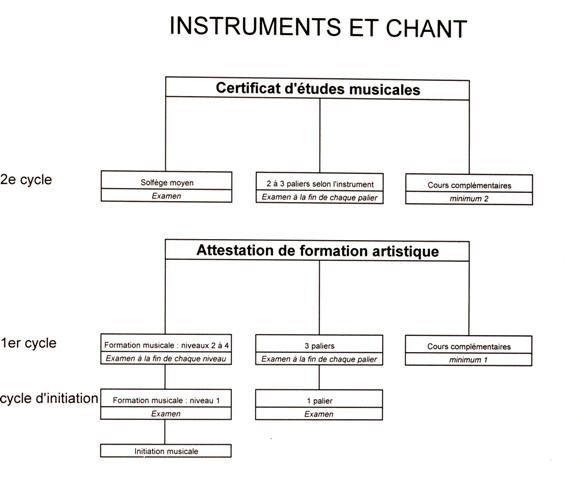
"Academic" program
CEGM Program
Regular exams
Regular auditions
Ensemble Music
"Free" program
Choice program
Optional exams
Optional auditions


STUDY PLAN


COURSES


MUSICAL CULTURE
COMPLEMENTARY COURSES MUSICAL CULTURE
INSTRUMENTS
COMPLEMENTARY COURSES INSTRUMENTS
MUSICAL THEATER
WORKSHOPS MUSIC AND HANDICAP
MUSIC THERAPY
HOLOSTHERAPY
LUMINO THERAPY AND SOUND MASSAGE


STUDY PLAN


The number of years in each level depends on the instruments and the length of the course.
 
COMPLEMENTARY COURSES
Harmony, History-Analysis.
Improvisation at the piano, collective Improvisation, Piano-jazz, Guitar-jazz, Electric guitar, 2nd instrument.
Ensemble Music, Chamber Music, Irish Ensemble.
Musical theater, Holostherapy, Lumino therapy & sound massage.
 

Depending on the case, a course followed externally may bde subject to equivalence.


COURSES


MUSICAL CULTURE

Musical Initiation, Musical Formation, Middle Solfeggio


Musical Initiation 
 
40 minutes weekly course
Awakening musical initiation from 3 years old : songs, rounds, finger games, percussion instruments, decoys, movements, rhythms, listening games accompanied with piano and/or guitar.
 
Musical Formation (formerly Elementary Solfeggio)
 
Individual, semi-collective or group lessons
Choral practice for adults.
Repetitions 2 times a month, 2 auditions a year. Repertoire : Christmas carols, classical, opera, popular, varieties.
 
Middle Solfeggio
 
Individual or group lessons

Deepening and broadening of knowledge and practices acquired during musical formation.


COMPLEMENTARY COURSES MUSICAL CULTURE

Harmony, History-Analysis


Harmony 
 
Individual, semi-collective or group lessons
Tonal and modal. Writing and analysis.

 
History-Analysis
 
Group lessons
Light on a composer by linking his work to the literary and pictorial creations of his time. The Analysis will be approached during the scores reading of the History course, then developed, by a specialized course.
All these courses are also illustrated with literary and pictorial presentations.


INSTRUMENTS

VoicePiano, Violin, Cello, Harp, Guitar, Electric guitar, Mandolin, Recorder, Flute, Clarinet, Saxophone

Individual courses
The musical formation is acquired. For goals to reach and age of admission see uder each instrument. It is recommended to consult the teacher before rending or buying the chosen instrument.


Voice 
 
The singing lessons are aimed at young people and adultsd who want to get a good voice that allows them to practice both classical and modern singing.
 
Piano
 
From 5 years old.
Instrumental mastery, through development :
- motor and sensory functions (adaptation to the instrument and its practice) ;
- senses (listening, imagination, touch, perception) ;
- communication (group games, public presentations, etc.).
 
Violin and Cello 
 
From 4 years old.
Holding the instrument and the bow. Justness and rhythm. That the pleasure of playing makes the student attentive to the necessity of the rigor of learning.
Then to give the student control of his instrument. That he/she can achieve autonomy.
That he/she knows how to listen to the others to play with them.
That at the end of the studies, he/she is able to put fingerings and bows him/herself and to to have a reflection on the work that he/she interprets.

 
Harp 
 
From 5 years old.
The teaching will be give on Celtic harps and pedal harps.
The work will focuse on both written music from all repertoires, as well as on oral music and improvisation.
The repertoire is vast : style said "classic" from the baroque to today, traditional music styles (Irish music in particular), popular style.

 
Guitar 
 
From 7-8 years old.
Technical and learning of the repertoire.
Solos, duets, trios and ensemble music.
Also flamenco and current music.

 
Electric guitar 
 
Improvisation, accompaniment, solo, theory, harmony, instrumental technique.
Genres : Rock, Pop, Blues, Funk, etc.

 
Mandolin 
 
From 7 years old.
Technique and use of the plectrum.
Learning the classical and popular repertoire.
Ensemble formations : duets, trios and plectrum orchestra.

 
Recorder 
 
From 5 years old.
Learning the recorder can begin very early.
The student is soon brought to play small pieces alone or in a duet, and during his/her studies, he/she will gradually become acquainted with others members of the recorder family, from highest to lowest.
This will allow to participate in the ensemble music.

 
Flute 
 
From 8-9 years old.
The objectives and form of evaluation are defined for each lever within a repertoire of pieces from all eras and all styles : baroque, classical, modern, jazz, popular, variety...

 
Clarinet 
 
From 9 years old.
This wooden instrument is known for its warm sound. The clarinet, with its diversity of colors and sounds, can play different styles : classical, jazz, contemporary, kletzmer.
This instrument, having differents registers, can be used in clarinet quartets, chamber music, orchestra or solo.

 
Saxophone 
 
From 9-10 years old.
It is an instrument halfway between wood and brass : by the simple reedbeak, it takes from the clarinet ; by the conical bore, it takes from the oboe ; by the metal, it takes from... the brass.
With this instrument, we can approach almost every musical style : classical, jazz, contemporary, etc.


COMPLEMENTARY COURSES INSTRUMENTS

Piano Improvisation, Collective Improvisation, Piano-jazz, Guitar-jazz, Chamber Music, Ensemble Music, Irish Ensemble


Piano Improvisation 
 
Introduction to the notion of improvisation, notions of practical harmony ( simple, complex chords, melody and accompaniment), rhythmic exercices, introduction to blues, jazz.
 
Collective improvisation
 
Pre-requisites : none
Instrument : with or without instruments
. The collective improvisation workshops approach improvisation in a free way allowing everyone to develop their creativity, to express their sensitivity to sound, to share music with others to create convivial musical moments.
Two types of workshops :
- for the non-musicians : the discovery of the sound world will have as tools the body expression, the percussive and melodic instrumental approach and the vocal programs;
- for musicians : sound exploration will use all available means (instruments, voice, body). The piano and the harps are on site.
Piano-jazz 
 
Ranges in modes. Tetrads. Arpeggios. Mechanism and articulation exercices.
Rhythmic characteristics of jazz : the swing, the mishaps, the ternary phrasing, the syncopations.
Themes : blues, standards, contemporary jazz.

 
Guitar-jazz 
 
Improvisation, accompaniment, solo, theory, harmony, instrumental technique.
Genres : Rock, Pop, Blues, Funk, etc.

 
Chamber Music 
 
The course is for all those who have a few years of instrumental practice want to share the joy of playing with other instrumentalists and thus form duets, trios, quartets, octuors...
The groups are organized according to their level with programs adapted to their possibilities.

 
Ensemble Music 
 
The teachers practice ensemble music in their instrument classes. Moreover, the instrumental ensembles are constituted in case os sufficient number of inscriptions.
The groups are organized according to their level with programs adapted to their possibilities.
Aim : to learn to play together, to listen to others.

 
Irish Ensemble 
 
Pre-requisites : minimum 2 years of instrumental practice.
For all ages and all levels. Program : dances, Irish and Celtic tunes... and good mood!
This workshop is eclectic by inviting all instruments that are not necessarily traditional.


MUSICAL THEATER


Creation workshop - musical tale 
 
Pre-requisites : none
Instrument : all instruments
This workshop is intended for children from 6 to 8 years old. Through sonic, instrumental (percussion, melodic instruments) and vocal as well as theatrical explorations, children will learn to create a musical tale.


WORKSHOPS MUSIC AND HANDICAP


These workshops are musical meditation workshops that use music or any sound source (percussion, voice, body, environment) in a process of communication between people by allowing the single expression of each.
In order to create homogeneous groups and in order to meet the needs of each person, an interview with each participant will take place beforehand.


MUSIC THERAPY

Receptive Music Therapy, Active Music Therapy

The psychology of music is an academic discipline that aims to study the reaction of a the person, the evolution through music, cognitive and mnemonic capabilities of the subject.


Receptive Music Therapy 
 
The subject listens to a sound program established after a psychological interview and a test of musical receptivity ; the sound program is established according to the age, the musical culture and the psychological problems of the patient.

For more information: www.atelierdelame.ch
 
Active Music Therapy 
 
This method is more focused on sound productions or voice work to facilitate the communication with adults or children in great difficulty (psychotic, autistic for example). The subject then expresses him/herself through music and sound. This allows the subject to acquire a better knowledge of his/her body and a mastery of his/her relationship with the others.nt.

For more information: www.atelierdelame.ch


HOLOSTHERAPY


This method created on the basis of quantum physics, takes into account the sounds, the vibration of the sounds, the frequencies emitted continuously by every living being.
Because we live in a world of frequencies, this positive or negative information has been encoded in us in a way that is sometimes inappropriate and ofter causes blocks. The Holostherapy is also based on the laying of the voice and the ability to emit sounds on the appropriate frequencies, according to the subhective needs.

For more information: www.atelierdelame.ch


LUMINO THERAPY AND SOUND MASSAGE


The sound vibration penetrates inside the body and re-harmonizes the cells; the singings bowls made of rock crystal are part of the range of rare instruments that make sound energy palpable because their frequencies are full of harmonics.
This therapy is used for the following different symptoms:
  • sleep disorder;
  • trouble falling asleep;
  • appetite disorder, gastric disturbances;
  • drowsiness during the day;
  • difficulty to concentrate, to think;
  • memory problems;
  • low mood, depression.
For more information: www.atelierdelame.ch